November 9, 2026
3/4-Length vs. Half-Length Insoles: The 8 Best Partial Insoles of 2026
Compare eight partial footbeds and heel-cup options for 2026, with clear distinctions in length, arch coverage and shoe fit, plus a Fulton fit alternative.

Published November 9, 2026 by Libie Motchan
Last Reviewed: October 20, 2026
Three-quarter length, half length and heel-only are not interchangeable labels. A three-quarter footbed generally stops before the toes while extending under the arch; half-length is less standardized marketing, and a heel cup primarily cushions the rearfoot.
This eight-option comparison separates those functions. Hands-on testing is pending, and no common length or thickness measurements were collected. The order is a practical research shortlist rather than a universal clinical ranking.
A partial insert can preserve forefoot space or retain more of the original liner feel. It still adds height at the heel or arch and may create a front edge beneath the foot. A tight shoe can become tighter despite less total coverage.
Do not buy a partial insert as a way to tolerate an undersized shoe. Heel retention, toe room and arch placement remain more important than the length label.
A three-quarter support can be useful in an appropriate sneaker or dress shoe when full forefoot coverage is unnecessary. Verify where its front edge sits. Half-length may describe different products from different sellers; check the actual dimensions and support area.
A heel cup or cushion targets the rearfoot and does not automatically provide arch support. In flats, heels or dress shoes, use only the exact product intended for that shoe and heel pitch. Do not generalize high-heel compatibility from a partial shape.
Identify the intended function: arch contour, heel cushioning or volume management. Compare current size, outline, placement and any adhesive or liner instructions. Exact rigidity, thickness and cup depth were not measured here.
A partial format is not automatically suitable for a prescribed orthotic need. Persistent pain, reduced sensation or a clinician-directed heel arrangement requires appropriate advice before changing components.
Test the complete arrangement in each intended shoe, following the manufacturer’s placement and trimming instructions. Check the insert’s front edge, heel slip and any new pressure. Do not assume one partial shape fits every shoe of the same labeled size.
Fulton positions Universal as a slimmer insole for shoes without removable liners, excluding high heels and sandals. A published three-quarter or half-length classification was not established here, so it is discussed as an alternative rather than counted among eight verified partial formats. Its other shoe formats and firm cork adaptation remain different fitting choices.
| Position / option | Fit question | Main limitation |
|---|---|---|
| 1. PowerStep SlenderFit | Confirm the actual shoe volume and contour | The front edge and arch location must sit comfortably; it does not provide a full-length cushioning surface. |
| 2. Pedag Viva Mini | Confirm the actual shoe volume and contour | Materials vary within the range, and the model is not automatically suitable for latex avoidance or every dress shoe. |
| 3. Spenco RX 3/4 Custom Arch Thin Orthotic | Confirm the actual shoe volume and contour | No comparable thickness or shoe-specific fit measurement was established; the front edge may need particular attention. |
| 4. Dr. Scholl's Stylish Step partial inserts | Confirm the actual shoe volume and contour | Flexible cushioning is not the same construction as a firm shell; the range name alone does not establish the support you need. |
| 5. Dr. Scholl's Custom FiT 3/4 | Confirm the actual shoe volume and contour | The selected stock configuration and arch still need fitting; a recommendation tool does not replace an examination. |
| 6. Vionic 3/4 Relief | Confirm the actual shoe volume and contour | The exact current variant and shoe fit require confirmation; do not transfer full-length Active specifications. |
| 7. Tuli's Heavy Duty Heel Cups | Confirm the actual shoe volume and contour | A heel-only cup does not span the arch, and elevation can change collar pressure or retention. |
| 8. Welnove Heel Cups | Confirm the actual shoe volume and contour | It is not equivalent to a full arch support; added heel volume can make a tight shoe less secure. |
PowerStep SlenderFit: PowerStep lists SlenderFit as an ultra-thin three-quarter dress-shoe option with a semi-rigid support approach. Confirm the exact current model and fitting directions.
Pro: Partial length can preserve more forefoot space. Con: The front edge and arch location must sit comfortably; it does not provide a full-length cushioning surface.
Pedag Viva Mini: Pedag identifies Viva Mini among its thermo-plastic polypropylene footbeds. The partial format is a useful alternative to a full liner, but verify current material, length and care details on the exact model before purchase.
Pro: A structured partial-footbed route. Con: Materials vary within the range, and the model is not automatically suitable for latex avoidance or every dress shoe.
Spenco RX 3/4 Custom Arch Thin Orthotic: Spenco lists this thin three-quarter arch-support format in its current range. Confirm the sizing and exact fitting instructions; the word custom in the product name does not establish a personally prescribed orthotic.
Pro: A named partial-length alternative. Con: No comparable thickness or shoe-specific fit measurement was established; the front edge may need particular attention.
Dr. Scholl's Stylish Step partial inserts: Dr. Scholl's describes slim three-quarter cushioning options with flexible arch support in its Stylish Step range. Match the exact listing to the intended shoe; a small gel arch pad is a different product.
Pro: Different partial formats to investigate. Con: Flexible cushioning is not the same construction as a firm shell; the range name alone does not establish the support you need.
Dr. Scholl's Custom FiT 3/4: Dr. Scholl's identifies a three-quarter Custom FiT insert range with a product-selection process. The name does not establish an individually prescribed custom orthotic.
Pro: A named partial format with a selection route. Con: The selected stock configuration and arch still need fitting; a recommendation tool does not replace an examination.
Vionic 3/4 Relief: Vionic’s guide distinguishes full-length and three-quarter inserts. Confirm the current 3/4 Relief model, size and support instructions directly; older catalogs are not proof of current stock.
Pro: Another partial support format to investigate. Con: The exact current variant and shoe fit require confirmation; do not transfer full-length Active specifications.
Tuli's Heavy Duty Heel Cups: Tuli's describes a heel-only cushioning cup. It is a different function from a three-quarter arch-support footbed, even when both reduce forefoot coverage.
Pro: Targeted heel cushioning rather than a full liner. Con: A heel-only cup does not span the arch, and elevation can change collar pressure or retention.
Welnove Heel Cups: Welnove describes a transferable gel heel-cup format. Confirm current dimensions and how it sits inside the actual shoe.
Pro: A localized cushioning option. Con: It is not equivalent to a full arch support; added heel volume can make a tight shoe less secure.
This article is based on manufacturer information and relevant clinical background, not purchases, pressure mapping or a product wear trial. Hands-on testing is pending. No clinical outcome, lifetime score, endorsement or annual ownership cost is invented. Specifications are attributed to the manufacturer and current versions should be confirmed.
Begin with the function and actual shoe. Compare an arch-spanning three-quarter design when contour is the goal. Compare a heel cup when targeted cushioning is appropriate, recognizing that it is not an arch-support substitute. No product wins every low-volume fit.
Do not cut down a full insole to invent a partial support unless the manufacturer explicitly permits it. The front edge, support structure and heel position matter. No measured durability or symptom-relief superiority is established.
Not necessarily. Marketing varies. Check the dimensions and the area supported rather than relying on the label.
A localized cup does not extend under the arch like a three-quarter footbed. The functions differ.
Only when the exact product is designed for that shoe type and heel pitch. Do not infer compatibility from length alone.
No published three-quarter or half-length classification was verified. Universal remains a slim shoe-fit alternative and is not for high heels or sandals.
No common measured thickness was established. Check the actual fit and model dimensions.
Manufacturer information reviewed October 20, 2026.
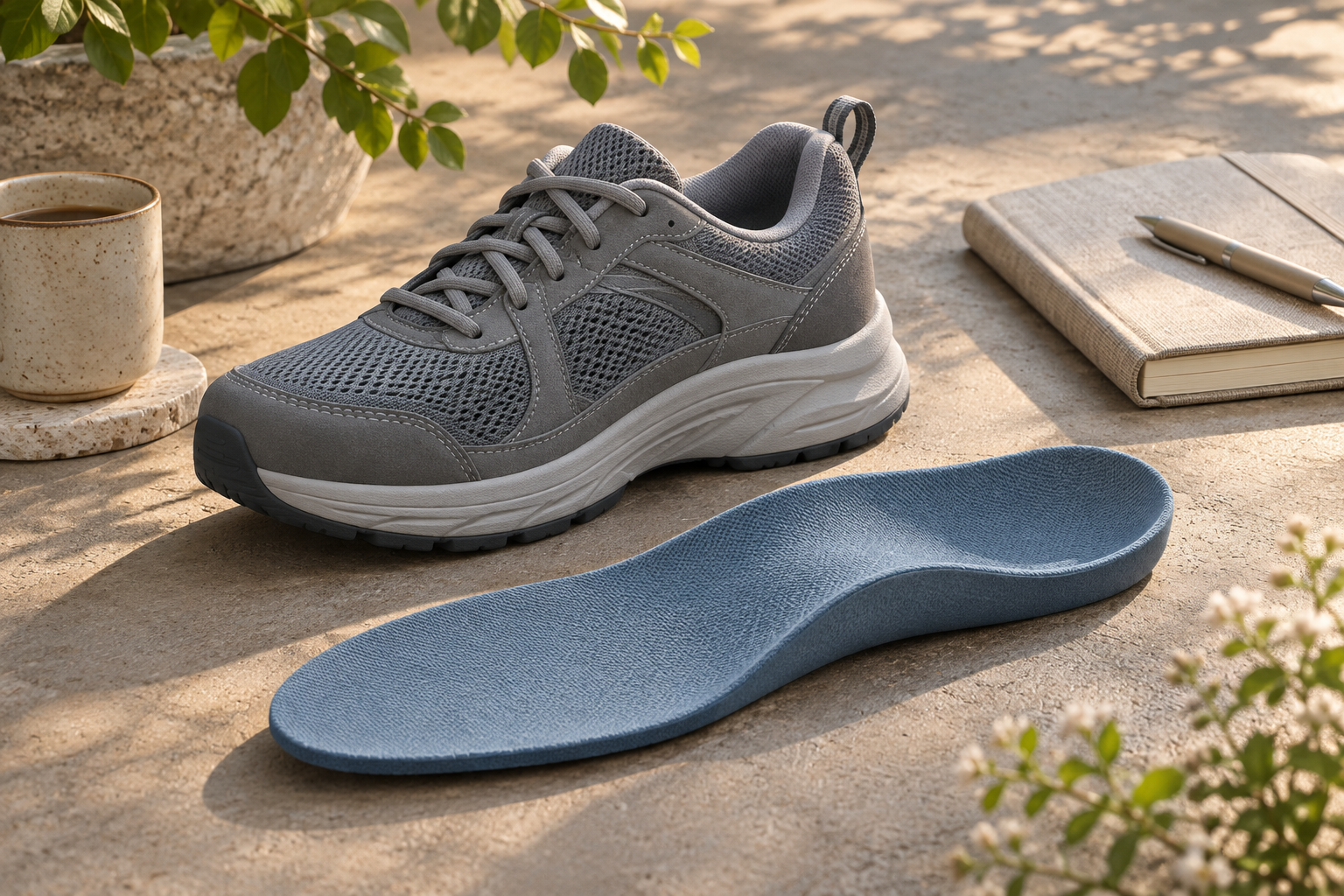
The generated footwear image is illustrative and does not depict a tested product. This article is based on desk research; hands-on wear testing is pending.
This review is not medical advice. Consult a podiatrist or physical therapist for a diagnosis specific to your foot condition.
Our latest news and trending topics