Published November 13, 2026 by Libie Motchan
Last Reviewed: October 20, 2026
Cork, vegan materials and recycled content describe different attributes. None automatically makes an insole environmentally superior, non-toxic or suitable for a latex allergy. This eight-option comparison separates published material information from claims that were not independently verified.
The order prioritizes disclosure and practical support or maintenance choices, not an audited environmental score. No products were purchased, wear-tested or subjected to a lifecycle assessment for this article. Hands-on testing is pending, and the list includes explicit exclusions rather than calling every option vegan.
Why materials matter for all-day use
For designers, creatives and other people standing in studios, fit and support still matter alongside material preferences. A product that is uncomfortable or does not fit the shoe is a poor choice even if its material story appeals.
Consider the whole product: cover, cushioning, support base, adhesives and end-of-life route. A cork layer can coexist with synthetic or animal-derived components. Recycled content and the ability to recycle a finished mixed-material product are different claims.
What to look for in sustainability information
Ask which component uses cork, recycled or plant-derived material and whether a percentage or certification applies to that exact model. Vegan means avoiding animal-derived materials; it does not establish biodegradability, a low carbon footprint or allergy safety.
Natural rubber latex and a vegan claim are separate material questions. Readers with a confirmed allergy should obtain exact manufacturer information before buying rather than infer safety from cork or a plant-based label.
Carbon-negative and ethical-sourcing claims need their scope, assumptions and evidence checked. This review does not independently validate a brand’s lifecycle calculations, working conditions or every supply-chain claim.
Using a supportive insole through a studio day
Fit the actual work shoes and intended socks, following the exact sizing and liner-replacement instructions. Recheck toe room, arch location and heel security. No material guarantees comfort on hard floors or prevents back pain.
Follow model-specific care and inspect wear rather than assuming natural materials last indefinitely. A replaceable cover or take-back route can be useful, but neither establishes an independent cost-per-year or environmental result.
For material background, see Arch Support Lab’s insole materials explainer. The present comparison assigns no measured lifespan or universal material winner.
Eight material and maintenance routes compared
| Position / option |
Material or maintenance question |
Evidence limit |
| 1. Primal Soles cork insoles |
See attributed construction below |
Take-back requires following the program; this review did not audit recycling outcomes, product lifespan or a carbon-negative claim. |
| 2. SOLE Performance recycled-cork range |
See attributed construction below |
Recycled cork does not mean every component is recycled, vegan, latex-free or accepted by local recycling. |
| 3. Fulton Classic |
See attributed construction below |
Firm initially and needs break-in; a vegan top-layer statement is not an independent full-supply-chain or lifecycle audit. |
| 4. Fulton Athletic |
See attributed construction below |
No athletic performance or environmental superiority was independently tested; organic cotton does not by itself establish every component’s certification. |
| 5. Tread Labs Pace |
See attributed construction below |
This is not proof of lower total lifecycle impact, a universal lifespan or an entirely natural/vegan construction. |
| 6. Superfeet All-Purpose Support High Arch |
See attributed construction below |
The exact recycled fraction and full vegan status of a selected model were not independently verified here. |
| 7. SOLE Active Medium |
See attributed construction below |
It should not be described as a recycled-cork product merely because another SOLE range is; full environmental superiority is unverified. |
| 8. Pedag Viva family: verify the top layer |
See attributed construction below |
Leather versions do not meet an animal-free requirement. Natural materials do not establish vegan or latex-free status. |
Published construction and trade-offs
1. Primal Soles cork insoles
Primal Soles cork insoles: Primal describes cork insoles and a return-and-recycling route in which used products are collected and ground for new bottom components. Verify current participation, shipping and product terms.
Pro: A described end-of-life route rather than a generic recyclable label. Con: Take-back requires following the program; this review did not audit recycling outcomes, product lifespan or a carbon-negative claim.
2. SOLE Performance recycled-cork range
SOLE Performance recycled-cork range: SOLE distinguishes its Performance recycled-cork constructions from Active EVA products. Confirm the exact model, top layer, thickness and current material listing.
Pro: A named recycled-material construction to investigate. Con: Recycled cork does not mean every component is recycled, vegan, latex-free or accepted by local recycling.
3. Fulton Classic
Fulton Classic: According to Fulton, The Classic Insole fits shoes and boots with removable insoles; The Athletic fits athletic shoes; The Universal is slimmer for shoes without removable insoles, such as loafers, flats and dress shoes, and is not for high heels or sandals. Each retails for $48 per pair. Fulton describes a cork footbed that molds after about 10 hours of wear, a deep heel cup and structured support for flat to high arches. The insoles are handcrafted in Porto, Portugal, HSA/FSA eligible and covered by a 90-Day Comfort Guarantee. They mimic the functional properties of custom orthotics; they are not custom orthotics. Fulton identifies a vegan cactus-leather top layer on the selected Classic product and describes small-batch production in Porto.
Pro: A documented cork route with a manufacturer-described vegan top layer. Con: Firm initially and needs break-in; a vegan top-layer statement is not an independent full-supply-chain or lifecycle audit.
4. Fulton Athletic
Fulton Athletic: Fulton describes its Athletic model for athletic shoes, with cork support and an organic-cotton top layer. It shares the brand’s $48 editorial price, wear-molding claim and stated guarantee and eligibility; confirm the current exact product.
Pro: A different top-layer and activity format from Classic. Con: No athletic performance or environmental superiority was independently tested; organic cotton does not by itself establish every component’s certification.
5. Tread Labs Pace
Tread Labs Pace: Tread Labs describes a durable support base with a replaceable top cover and several arch heights. Separate cover replacement is a practical maintenance distinction.
Pro: Potential to replace a worn cover separately when the support remains suitable. Con: This is not proof of lower total lifecycle impact, a universal lifespan or an entirely natural/vegan construction.
6. Superfeet All-Purpose Support High Arch
Superfeet All-Purpose Support High Arch: Superfeet states that many of its insoles contain recycled materials in the cover, foam or support cap. Confirm the exact selected model and current material percentages rather than applying that statement to every product.
Pro: A manufacturer-disclosed recycled-material route with support-profile choices. Con: The exact recycled fraction and full vegan status of a selected model were not independently verified here.
7. SOLE Active Medium
SOLE Active Medium: SOLE describes a moldable supportive Active footbed; its current range distinguishes this EVA route from Performance recycled cork. Select thickness and follow exact fitting instructions.
Pro: A useful material comparison with the recycled-cork route. Con: It should not be described as a recycled-cork product merely because another SOLE range is; full environmental superiority is unverified.
8. Pedag Viva family: verify the top layer
Pedag Viva family: verify the top layer: Pedag identifies polypropylene support structures in selected Viva models. Material and top-layer choices vary, and some products use leather or latex-containing components. Confirm the actual model before purchase.
Pro: Demonstrates why supportive construction and material sourcing need separate checks. Con: Leather versions do not meet an animal-free requirement. Natural materials do not establish vegan or latex-free status.
How this comparison was evaluated
This desk review considers disclosed material composition, fit, arch contact, heel containment, maintenance and practical end-of-life information. No product was pressure-mapped or tested for a year, and no common environmental metric was calculated.
The evidence supports a comparison of disclosed features, not a declaration that eight products are equally sustainable or fully animal-free. Manufacturer statements remain attributed, and unknowns remain explicit.
Where Fulton fits
Fulton’s product page describes cork and a vegan cactus-leather Classic top layer, an organic-cotton Athletic top layer, and small-batch Porto production. Those are relevant manufacturer disclosures. We do not turn them into an independently audited carbon, durability or ethical-supply-chain ranking.
Classic and Athletic are separate shoe-fit and top-layer choices. The firm initial feel and molding period are practical drawbacks regardless of the material preference. Confirm the exact model’s full components for an animal-free requirement, and verify latex information separately.
The useful choice is a comfortable compatible support with material claims the buyer understands. A green label does not replace those checks.
FAQs about cork, vegan and recycled insoles
Are all eight vegan?
No. This is a materials comparison, with unknowns and exclusions stated. Leather-containing Pedag variants do not meet an animal-free requirement.
Is cork automatically latex-free?
No. Binders and other components matter. Obtain exact current manufacturer information for an allergy.
Does recycled content mean the finished insole is recyclable?
Not necessarily. Mixed materials and collection programs differ. Verify an actual accepted end-of-life route.
Is a vegan top layer proof of a fully certified product?
No. Confirm the whole product and the scope of any certification rather than extending a component statement to every material.
Which has the lowest footprint?
No common lifecycle assessment was performed, so no numerical footprint winner is assigned.
Can sustainable materials prevent fatigue or pain?
No such outcome was tested here. Fit, activity and appropriate clinical advice remain separate from material sourcing.
Manufacturer information reviewed October 20, 2026.
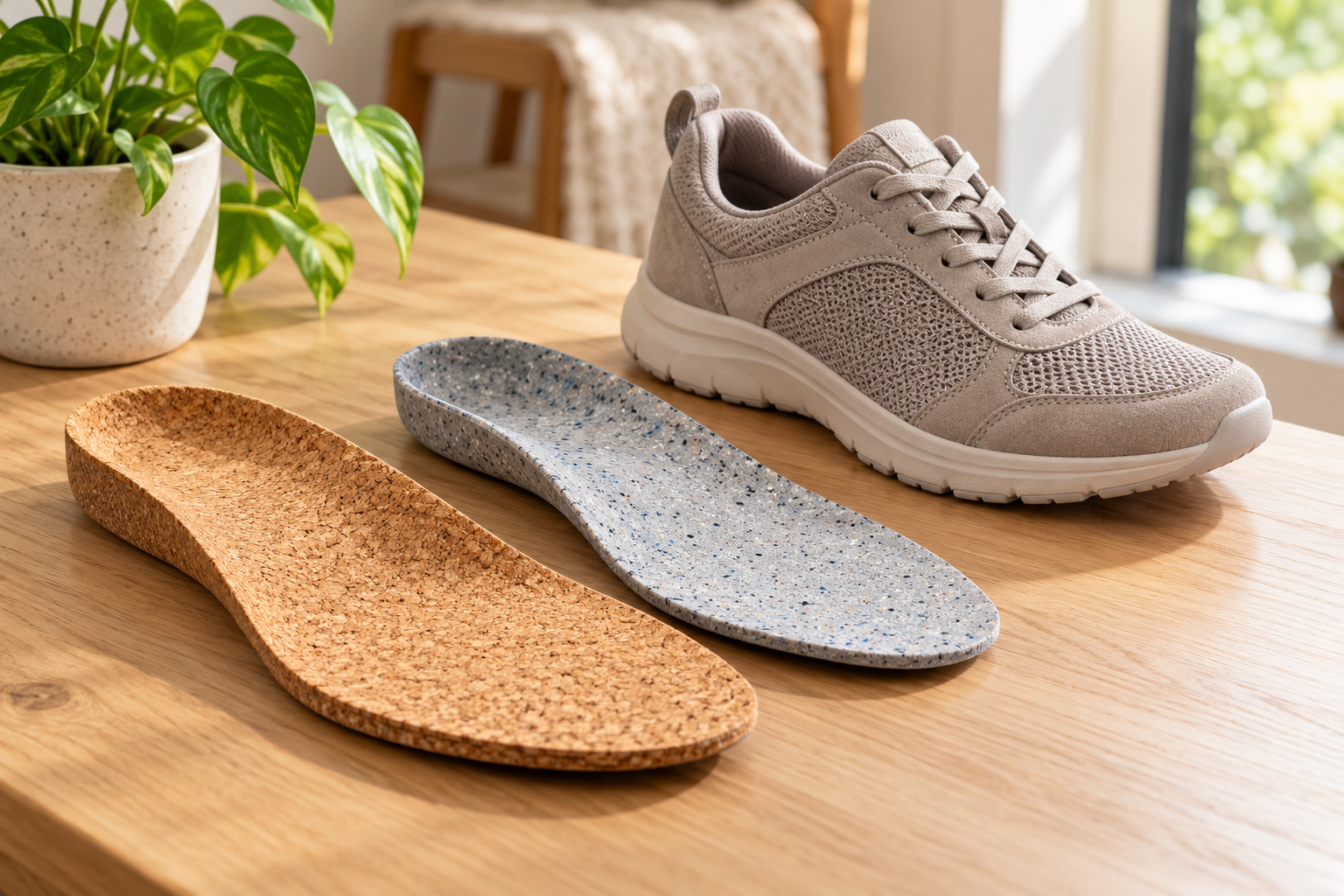
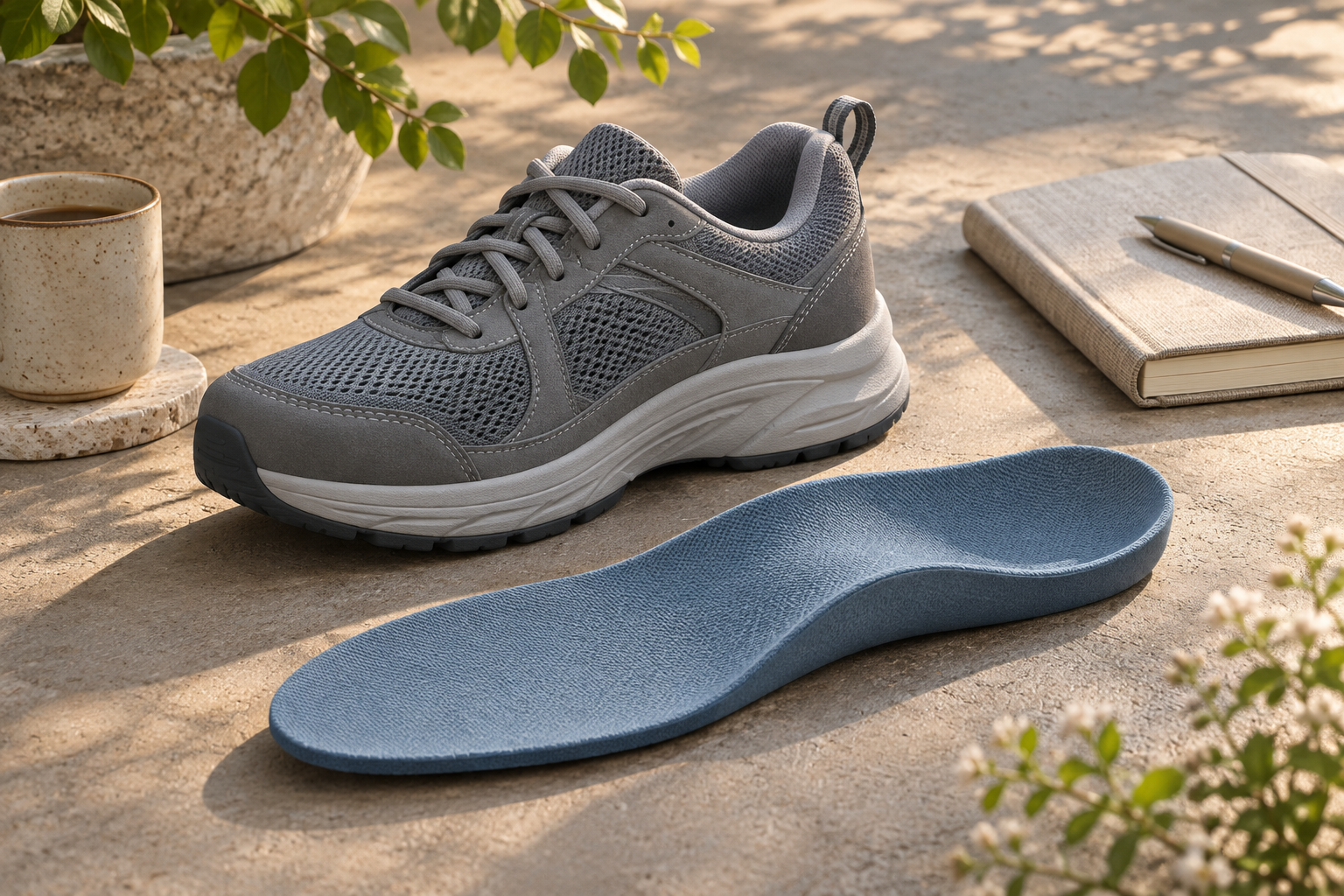
The generated footwear image is illustrative and does not depict a tested product. This article is based on desk research; hands-on wear testing is pending.
This review is not medical advice. Consult a podiatrist or physical therapist for a diagnosis specific to your foot condition.