November 6, 2026
8 Best Thin Insoles for 2026 That Still Deliver Real Arch Support
Eight thin and partial support options compared for arch contour, forefoot space and low-volume footwear, with model-specific drawbacks.

Published November 6, 2026 by Libie Motchan
Last Reviewed: October 20, 2026
A thin insole should add the needed contour while leaving room for the foot. It cannot make an undersized shoe fit. Low-profile, low-arch and partial-length describe different features, so they should not be treated as interchangeable labels.
This eight-brand comparison uses manufacturer descriptions rather than measured thickness or wear tests. Hands-on testing is pending. The order prioritizes clear shoe-volume guidance, support choices and practical fitting trade-offs, not an unverified claim that one model is the thinnest.
Loafers, flats and slim sneakers may have little removable depth. Adding a thick full-length insert can raise the heel, crowd the toes or increase pressure beneath the upper. A thinner or partial format may be worth comparing when a complete shoe still has enough room.
Thinness does not determine arch support by itself. A low-profile firm base can feel more defined than a thicker cushion, while a three-quarter insert can leave the forefoot free without being low everywhere. Stock liners are not automatically defective or disposable.
The goal is a comfortable complete fit. If the shoe already pinches without an insert, choose better-fitting footwear rather than using a support as a reason to tolerate pressure.
Compare full length versus three-quarter length, arch placement and heel height. A partial insert's front edge should not create a ridge under the foot. A low arch profile is not inherently appropriate for every foot that needs a thin product.
Check whether the existing liner should be removed. Shoes with glued-in liners may need a purpose-designed slim insert, but the result still has to fit without heel slip. Do not tear out a liner or stack products based on generic advice.
No common thickness measurements were collected here. Manufacturer terms such as ultra-thin are attributed descriptions, not a laboratory ranking. For prescribed orthotics, unusual pressure or persistent pain, seek the appropriate fitting advice.
Use the actual shoes and intended socks. Follow the selected product's sizing, trimming and placement instructions. Recheck toe movement, arch location and whether the heel remains secure. A partial product may shift differently from a full-length replacement liner.
Introduce a new contour according to its own guidance, watching for rubbing, numbness or increasing pain. Do not assume discomfort is a necessary correction. Compare a different shape or shoe if the added support changes fit adversely.
High heels and sandals have different requirements. Fulton Universal is specifically not for those categories. A brand may sell a separate heel-specific pad, but that does not make its full-length arch insert appropriate for the same shoe.
| Position / option | Construction focus | Fit / durability limitation |
|---|---|---|
| 1. Superfeet All-Purpose Support Low Arch | See manufacturer-attributed entry below | A low contour can still mismatch an individual arch; thin does not guarantee space in every loafer. |
| 2. PowerStep SlenderFit | See manufacturer-attributed entry below | The front edge and arch location must sit comfortably; it does not provide a full-length cushioning surface. |
| 3. Tread Labs Pace Thin | See manufacturer-attributed entry below | A thin cover does not eliminate the height of the support base; a tight upper can still be too tight. |
| 4. Pedag Viva Mini | See manufacturer-attributed entry below | Materials vary within the range, and the model is not automatically suitable for latex avoidance or every dress shoe. |
| 5. Spenco RX 3/4 Custom Arch Thin Orthotic | See manufacturer-attributed entry below | No comparable thickness or shoe-specific fit measurement was established; the front edge may need particular attention. |
| 6. Aetrex Thinsoles | See manufacturer-attributed entry below | A fixed contour still takes up space and can lift the heel; do not transfer construction details from Aetrex Conform or other ranges. |
| 7. Dr. Scholl's Stylish Step partial inserts | See manufacturer-attributed entry below | Flexible cushioning is not the same construction as a firm shell; the range name alone does not establish the support you need. |
| 8. Fulton Universal Insole | Cork support; $48 per pair | Firm initially, with break-in. It is not for high heels or sandals, and slim positioning does not guarantee compatibility with an already cramped shoe. |
Superfeet All-Purpose Support Low Arch: Superfeet describes a low-profile firm support design for tighter footwear, including appropriate shoes with or without removable liners. Its low arch profile is a specific choice, not merely a thinner version of every other Superfeet model.
Pro: Explicit low-profile footwear positioning. Con: A low contour can still mismatch an individual arch; thin does not guarantee space in every loafer.
PowerStep SlenderFit: PowerStep lists SlenderFit as an ultra-thin three-quarter dress-shoe option with a semi-rigid support approach. Confirm the exact current model and fitting directions.
Pro: Partial length can preserve more forefoot space. Con: The front edge and arch location must sit comfortably; it does not provide a full-length cushioning surface.
Tread Labs Pace Thin: Tread Labs describes firm support in four arch heights with a thin replaceable cover. Match the chosen contour and outline to the shoe.
Pro: Multiple arch choices with separate cover replacement. Con: A thin cover does not eliminate the height of the support base; a tight upper can still be too tight.
Pedag Viva Mini: Pedag identifies Viva Mini among its thermo-plastic polypropylene footbeds. The partial format is a useful alternative to a full liner, but verify current material, length and care details on the exact model before purchase.
Pro: A structured partial-footbed route. Con: Materials vary within the range, and the model is not automatically suitable for latex avoidance or every dress shoe.
Spenco RX 3/4 Custom Arch Thin Orthotic: Spenco lists this thin three-quarter arch-support format in its current range. Confirm the sizing and exact fitting instructions; the word custom in the product name does not establish a personally prescribed orthotic.
Pro: A named partial-length alternative. Con: No comparable thickness or shoe-specific fit measurement was established; the front edge may need particular attention.
Aetrex Thinsoles: Aetrex positions Thinsoles for footwear without removable depth, with its arch support and microfiber top cover. Confirm the current variant and dimensions.
Pro: Specifically aimed at limited-depth shoes. Con: A fixed contour still takes up space and can lift the heel; do not transfer construction details from Aetrex Conform or other ranges.
Dr. Scholl's Stylish Step partial inserts: Dr. Scholl's describes slim three-quarter cushioning options with flexible arch support in its Stylish Step range. Match the exact listing to the intended shoe; a small gel arch pad is a different product.
Pro: Different partial formats to investigate. Con: Flexible cushioning is not the same construction as a firm shell; the range name alone does not establish the support you need.
Fulton Universal Insole: According to Fulton, The Classic Insole fits shoes and boots with removable insoles; The Athletic fits athletic shoes; The Universal is slimmer for shoes without removable insoles, such as loafers, flats and dress shoes, and is not for high heels or sandals. Each retails for $48 per pair. Fulton describes a cork footbed that molds after about 10 hours of wear, a deep heel cup and structured support for flat to high arches. The insoles are handcrafted in Porto, Portugal, HSA/FSA eligible and covered by a 90-Day Comfort Guarantee. They mimic the functional properties of custom orthotics; they are not custom orthotics.
Pro: A cork option explicitly intended for shoes without removable liners. Con: Firm initially, with break-in. It is not for high heels or sandals, and slim positioning does not guarantee compatibility with an already cramped shoe.
The rubric considers arch contact, heel containment, cushioning, material durability, breathability and value over time. This article uses manufacturer information and identifies fit questions; it does not report an independent product trial. No insoles were purchased, pressure-mapped or tested for months. Hands-on wear testing is pending. No measured annual cost, lifespan or clinical score is assigned, and the order can change when better evidence or a different fit is available.
Start with how much depth can be added, whether the liner removes, and which contour feels appropriate. Superfeet Low Arch and Tread Labs Thin offer different support-profile routes. PowerStep, Pedag and Spenco offer partial formats. Aetrex targets limited-depth footwear; Dr. Scholl's offers cushioning-oriented partial options. Fulton Universal provides the cork alternative with a firm initial feel.
A slim insole may be useful in a loafer or narrow shoe, but no model guarantees a fit. Choose the shoe first and confirm heel security after adding support. Do not choose solely by the word thin or by a ranking position.
The construction trade-off is often less forefoot coverage or less cushioning in exchange for space. That trade-off can be worthwhile without implying that a thin insert supplies the same feel as a thicker athletic liner.
Yes, some use a firm shaped base despite a low profile. The contour still needs to match the foot and shoe.
A common measured thickness was not established, so this review does not claim a millimeter winner.
No. One describes length; the other usually refers to how much shoe space a product occupies.
No. Adding material can worsen crowding. Reassess the footwear if there is pressure, numbness or heel slip.
Compare products explicitly intended for that use, including the selected Superfeet, Aetrex and Fulton models. Actual depth and contour remain decisive.
No. Fulton specifies that it is not for high heels or sandals. Use the correct shoe-specific product and fitting guidance.
Manufacturer information reviewed October 20, 2026.
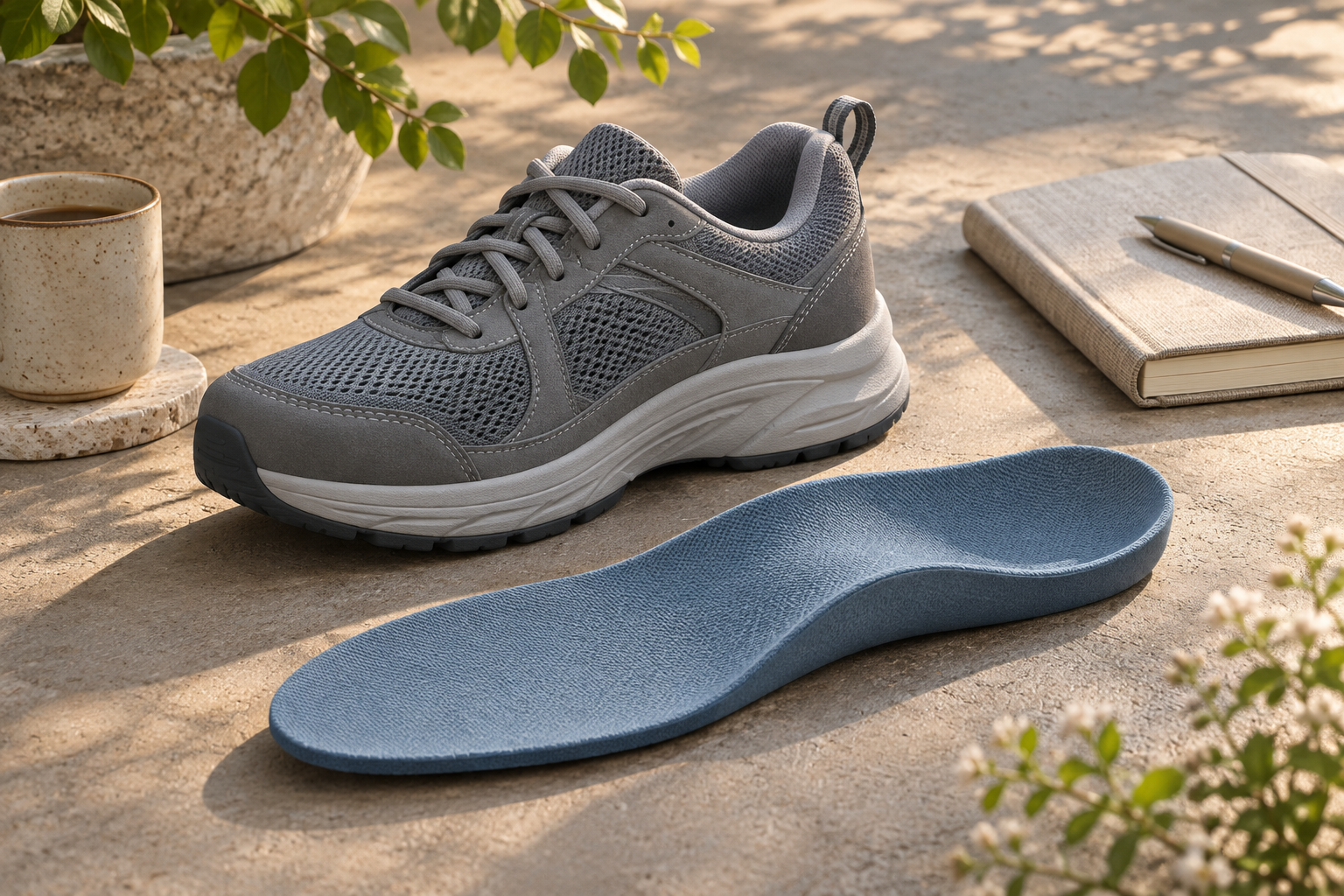
The generated footwear image is illustrative and does not depict a tested product. This article is based on desk research; hands-on wear testing is pending.
This review is not medical advice. Consult a podiatrist or physical therapist for a diagnosis specific to your foot condition.
Our latest news and trending topics